
Make better decisions with better data.
B2B commerce optimization that connects to commercial outcomes.
Talk to us →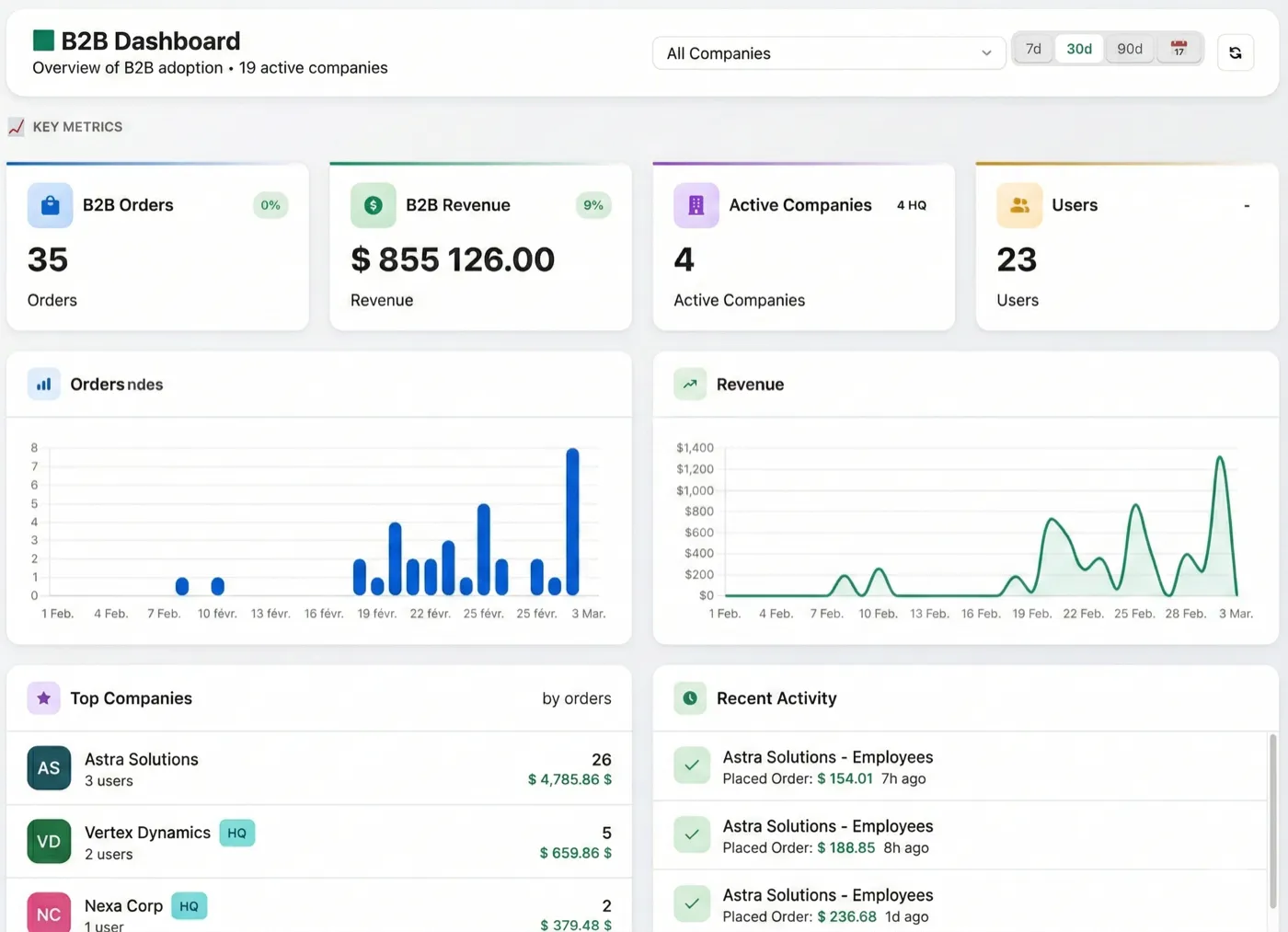
Services
Measure & Optimize
B2B commerce optimization isn't about running Facebook ads. It's about understanding how your digital channel performs against your operational reality — adoption rates, order frequency, average order value by segment, digital penetration against total revenue, and the gap between what your sales team quotes and what customers can do online.
We build the measurement framework and then optimize against it. From AI-powered process automation to search tuning to technical performance — every improvement is tied to a commercial outcome.
Contact usWe also offer strategy & consulting and platform integration — same team, one roadmap.
AI-Powered Optimization
- Deploy AI tools for product data enrichment, content optimization, and demand forecasting
- Implement Generative Engine Optimization (GEO) to ensure your products surface in AI-driven search and purchasing
- Prepare for agentic commerce — structure product data for Google UCP, ChatGPT shopping, and Copilot Checkout
- Automate repetitive workflows across catalog management, order processing, and customer communications
B2B Analytics & KPI Frameworks
- Build executive dashboards separating B2B from B2C performance for clearer decision-making
- Define and track B2B-specific KPIs: digital penetration rate, reorder frequency, self-serve adoption, time-to-first-order
- Integrate ERP and CRM data into commerce reporting for full-funnel visibility
- Translate analytics into actionable growth strategies — not just dashboards
Technical Performance & CRO
- Improve page speed and Core Web Vitals for SEO and conversion
- Refine Algolia and Bloomreach search configuration for relevance, speed, and B2B-specific query patterns (SKU, part number, specification)
- Audit technical SEO with prioritized fixes tied to revenue impact
- Optimize checkout flows, reordering UX, and account management for B2B buyer behavior
Retention & Lifecycle Automation
- Set up Klaviyo flows for reorder reminders, account activation, win-back sequences, and post-purchase engagement
- Segment by customer type, order history, lifecycle stage, and reorder patterns
- Sync HubSpot CRM with Shopify for unified contact profiles, pipeline visibility, and churn detection
- Build retention dashboards tracking reorder frequency, customer lifetime value, and churn rate by segment
Adoption
B2B Adoption — The KPI Nobody Tracks
Most B2B eCommerce projects are measured by traffic, conversion, and AOV. But the metric that actually determines ROI is adoption — both internal and customer.
Internal adoption means your sales reps, CSRs, and branch staff are using the platform to manage accounts, place orders, and serve customers — instead of working around it. If your team isn't in the system, your data is incomplete and your digital investment is underperforming.
Customer adoption means your buyers are self-serving: placing reorders, checking inventory, downloading invoices, and managing their accounts online — instead of calling in. This is where the real efficiency gain lives.
We've built custom dashboards and Shopify apps that track both: digital order penetration by rep, customer activation rates, self-service vs. assisted orders, and reorder frequency by channel. These aren't vanity metrics — they're the numbers that tell you whether your B2B platform is actually working.
At Lumen/Sonepar, tracking and driving adoption was how we sustained four consecutive years of double-digit online growth. The technology was table stakes. The adoption strategy was the differentiator.
Retention
Keep them buying — automatically
In B2B, acquiring a customer costs 5–25x more than retaining one. But most B2B eCommerce teams spend 90% of their energy on acquisition and almost nothing on keeping the customers they already have. No reorder reminders. No win-back sequences. No visibility into who stopped buying and why.
Klaviyo automation is where the leverage is. We build flows that trigger based on real purchasing behavior — not marketing calendars. Reorder reminders timed to each customer's actual buying cycle. Account activation sequences for new B2B accounts that haven't placed a second order. Win-back campaigns for accounts that have gone quiet. Post-purchase flows that drive product adoption and cross-sell.
CRM-driven retention connects the dots between sales and marketing. We sync HubSpot with Shopify so your team sees a unified view: order history, lifecycle stage, engagement signals, and churn risk — in one place. When an account's reorder frequency drops, your rep knows before the customer leaves.
Repeat purchase optimization means making it effortless to buy again. Quick order forms, saved carts, one-click reorder from order history, and B2B-specific UX that eliminates friction for high-frequency buyers. The best retention strategy is a platform that's easier to use than calling your rep.
We measure what matters: reorder frequency by segment, customer lifetime value, churn rate, time between orders, and reactivation rate. These aren't marketing metrics — they're the numbers that tell you whether your B2B relationships are growing or shrinking.

What This Means for Your Business
- Know what's actually driving revenue Attribution beyond last-click, connecting offline and online B2B sales.
- Identify conversion bottlenecks Funnel analysis specific to B2B buying cycles, not B2C metrics.
- Benchmark against industry Performance context for manufacturers and distributors, not generic eCommerce.
- Continuous improvement, not one-time audit Ongoing optimization cadence tied to business reviews.