
Canadians love AI. Canadian companies still can’t cash it in.
Canadians rank second in the world for AI use per capita and second-last in the G7 for productivity — adoption is not transformation.

The short version
Anthropic's first Canadian country brief ranks Canada eighth globally in Claude usage, more than four times what population size predicts, while every hour worked here produces about 17% less value than the G7 average. Individual adoption shows up in usage data; only firm-level investment shows up in GDP per hour.
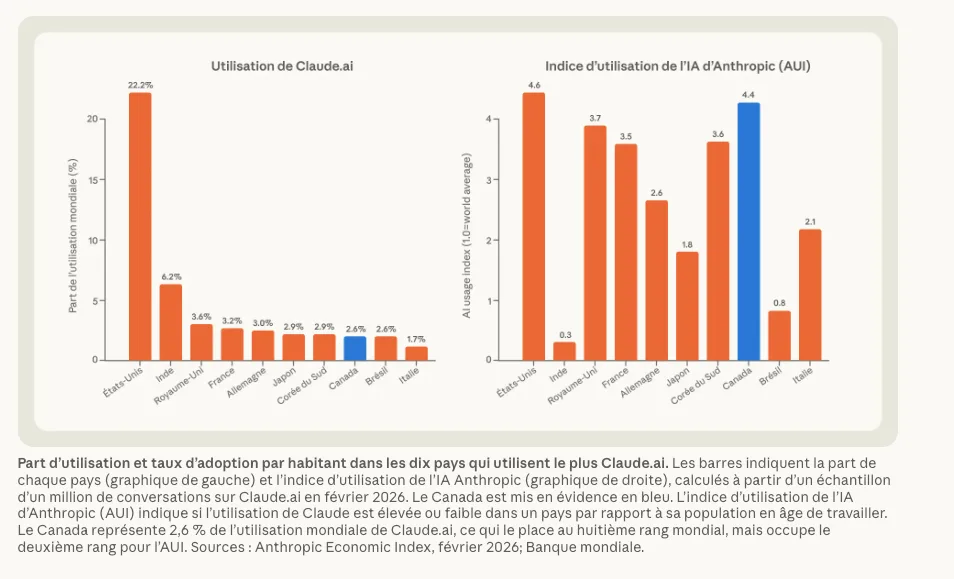
Anthropic just published its first Canadian country brief, and one number should make every executive in this country uncomfortable.
Canada ranks eighth in the world in Claude usage. Per person, Canadians use Claude at more than four times what our population size predicts. Among the ten heaviest-using countries, only Americans use it more per capita.
We are, per capita, one of the most AI-curious populations on the planet.
Now hold that against the other number. Every hour worked in Canada produces about 17% less value than the G7 average. Over the past three decades, we’ve had the second-lowest labour productivity in the G7, ahead of only Japan. Against the United States, we produce roughly 30% less per hour worked, and the gap keeps widening.
Second in #AI adoption. Second-last in productivity.
That’s not a coincidence waiting to resolve itself. That’s a diagnosis.
Adoption is not transformation
The optimistic read is that we’re early. Millions of Canadians experimenting with AI today becomes a productivity boom tomorrow.
I don’t buy it. Remote work was supposed to unlock a productivity boom too. So was the first wave of AI tools. Neither showed up in the statistics.
Because individual adoption and firm-level productivity are two different games. A product manager in Mississauga using Claude to draft emails faster is adoption. A distributor rebuilding its quoting process so a rep closes in one call instead of four is transformation. The first shows up in Anthropic’s usage data. Only the second shows up in GDP per hour.
And the second one requires something Canadian companies have chronically refused to do: invest. The Conference Board of Canada attributes our productivity gap to lower business investment in machinery, equipment, and intellectual property. Not lazy workers. Not bad universities. Under-capitalized firms.
AI doesn’t fix that pattern. It exposes it.
Where the usage actually is
The provincial breakdown tells you exactly who’s moving. British Columbia leads in per-person use, Ontario has the largest share of conversations, and usage runs highest where professional, scientific, and technical work is concentrated.
Knowledge workers. Consultants. Developers.
You know who’s missing from that picture? The industrial economy. Distribution, manufacturing, wholesale. The sector that runs on ERPs installed when Chrétien was Prime Minister.
That’s the part of the economy where the productivity gap actually lives. And it’s the part where AI can’t help yet, because AI has nothing clean to work with. You can’t put an AI agent on top of a product catalog where 40% of the SKUs are missing attributes and the pricing logic lives in a sales rep’s head. The model will confidently automate your garbage.
The durable investment isn’t the AI layer. Models refresh every quarter. The data layer is what compounds: governed product information, structured pricing, documented business rules. That’s the machinery-and-IP investment Canadian firms keep skipping, now wearing an AI costume.
The Quebec story is stranger than the national one
I live this contradiction from Montréal.
This city hosts Mila, the largest concentration of academic deep learning researchers in the world. The Université de Montréal helped keep neural network research alive when the rest of the field had written it off. Anthropic’s $10 million commitment to Canadian institutions includes Mila and Université Laval, where researchers will study how language models handle Quebec French and Indigenous languages.
We invented a good chunk of this technology. So what does Quebec actually use Claude for?
Translation. Quebec leads the country, alongside New Brunswick and Nova Scotia, in translation requests. It tracks government employment and bilingualism requirements. The most common AI use case in the province that birthed deep learning is a compliance task.
I’d laugh, except there’s a serious business insight buried here. If you sell products in Quebec, Law 96 made bilingual content a legal obligation, not a nice-to-have. Every SKU needs French product names, descriptions, and specs. For a distributor with 50,000 products, that’s not a translation job. That’s a product data architecture problem. The companies solving it with copy-paste into a chatbot are burning the exact hours that AI-enriched, PIM-governed catalogs eliminate.
And Quebec has less room for waste than anyone. Business investment here averaged 15.9% of GDP from 2000 to 2022, below Ontario and well below the 23.2% in the rest of Canada.
Yet something is shifting. In 2024, Quebec was one of only two provinces where business productivity actually rose. The GDP-per-capita gap with Ontario has narrowed from 13.7% to about 9% since 2018. Quebec is the one place in the country where the line is bending the right way. The question is whether its mid-market manufacturers and distributors press the advantage or hand it back.
The newsletter · Twice a month
Get the next one before LinkedIn does.
Real B2B commerce implementations. PIM, ERP and eCommerce integrations that work. What to do Monday, in your inbox.
2,050+ operators. Unsubscribe in one click.
The Alberta counter-example
It’s not hopeless, and the same report proves it. Alberta’s Ministry of Technology and Innovation used Claude Code to review 466 million lines of code across provincial systems in roughly 20 hours, then shared their methods with other governments.
A provincial government. Not a startup, not a bank with a nine-figure innovation budget. They picked one brutal, well-scoped problem and pointed AI at it with real institutional commitment.
That’s the template for a mid-market distributor too. Not “we bought licenses for everyone.” One process, fully rebuilt. Measured before and after.
What this means if you run digital at a distributor
Your employees are already in the adoption data. Canadians clearly don’t have an appetite problem. The question is whether that curiosity converts into anything your CFO can see.
Three tests worth running this quarter.
First, audit where AI could touch revenue, not convenience. Email drafting saves minutes. Cutting quote turnaround from three days to three hours changes win rates.
Second, check whether your product data could survive an AI layer. Ask a model questions about your own catalog. If the answers embarrass you, data governance is the project, not the AI. In Quebec, run the same test in French.
Third, pick one Alberta-sized problem. Bounded, painful, measurable. Ship it in ninety days and put a number on it.
We’re now the second-most enthusiastic AI users in the developed world, attached to the second-least productive G7 economy. One of those numbers is going to move toward the other.
Which direction is a choice your company makes.
Sources (for your reference, verify before adding footnotes)
Anthropic, “Anthropic commits $10 million to Canadian AI research,” July 14, 2026 — usage rankings, provincial data, Alberta case study, Mila/Laval partnerships
Montreal Economic Institute (2023) — Canada 17% below G7 average per hour worked; 6th of G7 ahead of Japan
Library of Parliament HillNotes (2025) — second-lowest labour productivity in G7 over three decades
McKinsey / OECD — ~30% labour productivity gap vs. US
Conference Board of Canada — gap attributed to low business investment in machinery, equipment, IP
Fraser Institute (2024) — Quebec business investment 15.9% of GDP vs. 23.2% rest of Canada, 2000–2022
Statistics Canada (May 2025) — Quebec one of two provinces with rising business productivity in 2024
Desjardins (Feb 2026) — Quebec–Ontario GDP-per-capita gap narrowed from 13.7% (2018) to ~9.2% (2024)
Questions I get on this
FAQ
Does heavy AI usage predict a productivity boom?
Remote work and the first wave of AI tools never showed up in the statistics either. A product manager drafting emails faster is adoption; a distributor rebuilding quoting so a rep closes in one call is transformation.
Why is Canadian productivity so low?
The Conference Board of Canada attributes the gap to lower business investment in machinery, equipment and intellectual property. Under-capitalized firms, not lazy workers.
Which sectors are missing from the AI usage data?
The industrial economy. Usage concentrates where professional, scientific and technical work sits, while distribution, manufacturing and wholesale still run on decades-old ERPs.
AI & GEO
Want this built with your team?
What AI engines say about you today, and what makes them say something better.
Scope, timeline and what your team owns at the end.